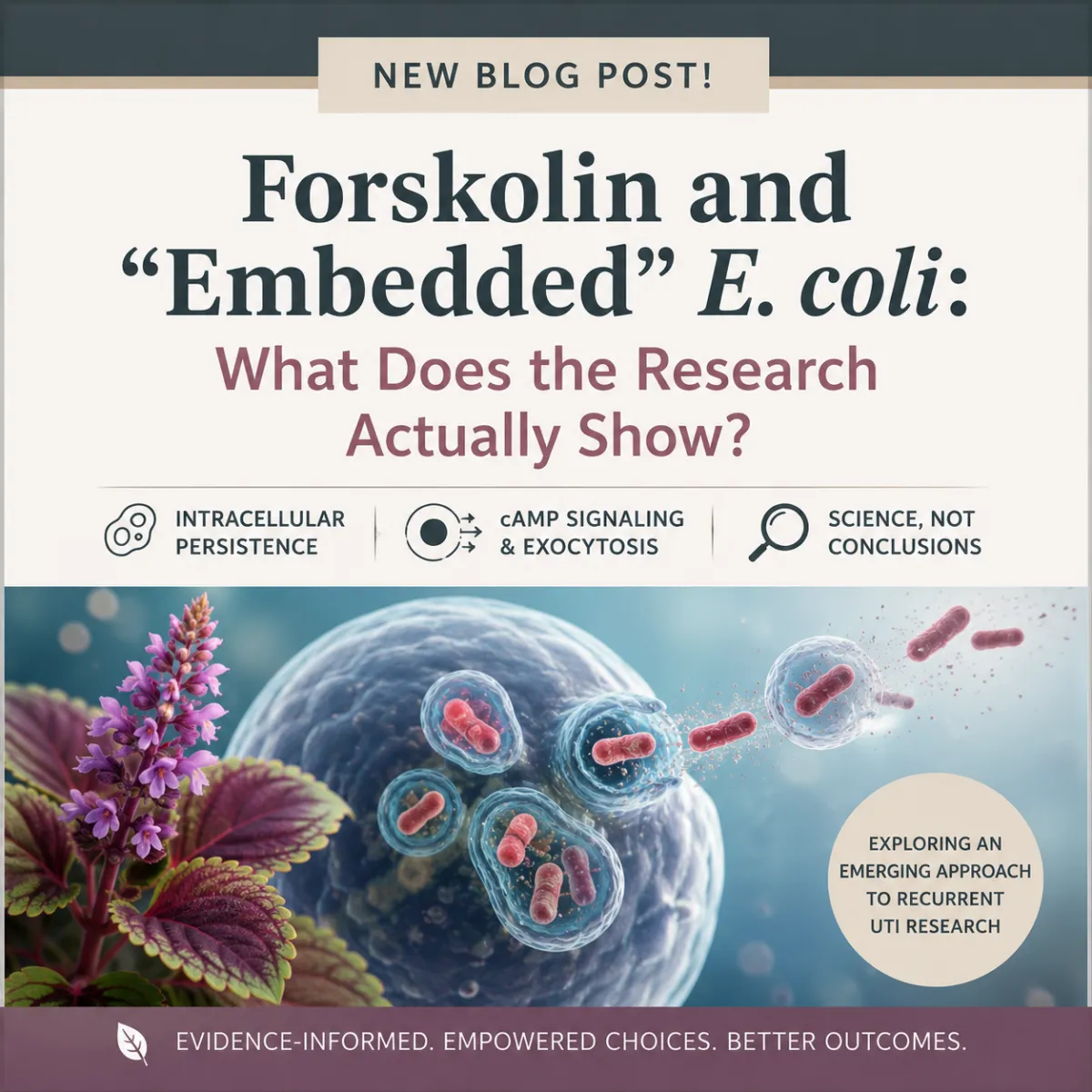
Forskolin for Recurrent E. coli UTIs: What Does the Research Show?
From Herbal UTI Healing: Evidence-informed education to help women better understand recurring UTIs and the factors that may contribute to them.
If you’ve been dealing with recurrent E. coli UTIs, you may have heard people talk about “embedded bacteria,” biofilms, or bacteria hiding inside the bladder wall.
Forskolin sometimes comes up in those conversations as a possible way to “flush out” hidden E. coli.
The research behind that idea is genuinely interesting.
But there is also an important difference between what forskolin has been shown to do in laboratory research and what has actually been proven in women with recurrent UTIs.
Here’s what we know so far.
First, can E. coli really get inside bladder cells?
Yes.
Certain strains of UTI-causing E. coli, often called uropathogenic E. coli or UPEC, can enter cells lining the bladder during infection.
Researchers have even found evidence of intracellular bacterial communities in urine samples from women with acute cystitis. In one study of 80 women with acute uncomplicated cystitis, signs of intracellular bacterial communities were found in 18% of urine samples.
This does not mean that every recurrent UTI is caused by bacteria hiding inside bladder cells.
It also does not mean that a negative urine culture automatically proves an “embedded infection.”
But it does show that an intracellular stage of E. coli infection is biologically real.
So where does forskolin come in?
Forskolin is a natural compound found in the plant Coleus forskohlii.
What makes forskolin interesting is that it does not appear to work like an antibiotic.
Instead, it acts on the bladder cell itself.
Forskolin increases a signaling molecule inside cells called cyclic AMP, or cAMP.
You can think of cAMP as one of the cell’s internal messengers.
Bladder cells normally use this signaling system to move small storage compartments, called vesicles, toward the surface of the cell.
Researchers discovered that UPEC can sometimes take shelter inside these vesicles.
When scientists increased cAMP using forskolin, the bladder cells moved those bacteria-containing vesicles toward the cell surface and expelled the bacteria back outside the cell.
In other words:
Forskolin did not kill the bacteria. It caused the host bladder cell to push some of the intracellular bacteria back out.
This mechanism was demonstrated in bladder-cell experiments and in mouse UTI models.
Is forskolin a “biofilm disruptor”?
Not in the way that term is usually used.
A typical biofilm is an extracellular bacterial community protected by a matrix made from substances such as polysaccharides, proteins, extracellular DNA, and other materials.
Forskolin has not been shown to simply dissolve that matrix.
Instead, the research we reviewed suggests that forskolin is better thought of as an experimental intracellular bacterial mobilization strategy.
That distinction matters.
Bacteria protected inside a bladder cell and bacteria protected inside an extracellular biofilm are not necessarily the same problem.
And they may not respond to the same tools.
What happens after the E. coli comes out?
This is another important part of the research.
The bacteria expelled from the bladder cells are still alive.
The potential advantage is that once they are outside the cell, they may be easier for other defenses or treatments to reach.
In experimental research, scientists explored this idea alongside antibiotics. The concept is that bacteria protected inside host cells may become more vulnerable once they are returned to the extracellular bladder environment.
That makes biological sense.
But it does not mean we currently have a proven human “flush and kill” protocol using forskolin.
Has oral forskolin been tested in women with recurrent UTIs?
This is where the evidence becomes much thinner.
One small human study evaluated a combination supplement in women with recurrent uncomplicated cystitis.
The forskolin-containing formula also included:
D-mannose
berberine
arbutin
birch extract
Coleus forskohlii
The Coleus extract provided about 3 mg of active forskolin per day.
Women taking the forskolin-containing combination had favorable recurrence outcomes during the study.
That sounds promising, but there is a major limitation:
Forskolin was not tested by itself.
Several active ingredients were taken at the same time, so researchers could not determine which ingredient—or combination of ingredients—was responsible for the results.
The study also did not measure whether forskolin actually caused intracellular E. coli to leave bladder cells in the women taking it.
So this study gives us an interesting human signal, but it does not prove the forskolin mechanism occurred.
The biggest unanswered question: does oral forskolin reach the bladder?
This may be the most important evidence gap.
The laboratory studies showing bacterial expulsion exposed cells directly to forskolin.
The animal studies used methods such as placing forskolin directly into the bladder or administering it systemically.
Those experiments often used forskolin concentrations in the range of roughly 10 to 100 micromolar.
What we do not currently have is good evidence showing:
how much forskolin enters the bloodstream after ordinary oral supplementation;
how much reaches human bladder tissue;
whether it reaches concentrations high enough to activate the same pathway;
or whether oral forskolin causes intracellular UPEC expulsion in women.
That is why the statement:
“Oral forskolin flushes embedded E. coli out of your bladder”
goes beyond the evidence we currently have.
So is the forskolin research useless?
Not at all.
I actually think it points to something very important about recurrent UTIs.
We often hear people talk about finding the “strongest biofilm disruptor.”
But recurrent infection may involve several very different persistence problems.
For example, bacteria may be:
circulating freely in the urinary tract;
protected within an extracellular biofilm;
associated with stones or other surfaces;
repeatedly reseeding the urinary tract from another location;
or, in some cases, occupying intracellular niches.
Those are not necessarily the same problem.
And understanding where bacteria may be persisting could eventually help researchers develop much more targeted approaches.
Forskolin is interesting because it represents a different idea:
Instead of attacking the bacteria directly, researchers are studying whether we can manipulate a host-cell pathway that helps move intracellular bacteria back into a more exposed location.
That is a fascinating area of research.
It just isn’t a proven oral treatment yet.
What We Know vs. What We Don’t Know
What the research supports
Forskolin can increase cAMP and stimulate bladder cells to expel intracellular UPEC in laboratory and animal models.
Intracellular bacterial communities have also been observed in women with acute E. coli cystitis.
A small human study found favorable outcomes with a multi-ingredient recurrent-UTI formula that included low-dose Coleus forskohlii.
What has not been established
We do not yet know that oral forskolin:
reaches effective concentrations in the human bladder;
expels intracellular E. coli in women;
clears a chronic intracellular bacterial reservoir;
prevents recurrent UTI when used alone;
or has an established dose for this purpose.
That distinction is important.
The Bottom Line
Forskolin is one of the more interesting experimental ideas I’ve found in the research on recurrent E. coli UTIs.
The underlying mechanism is supported by laboratory and animal research: increasing cAMP can cause bladder cells to expel intracellular UPEC.
Researchers have even begun exploring Coleus forskohlii in human recurrent-UTI formulations.
But we are not yet at the point where the evidence supports saying that an oral forskolin supplement can “flush embedded E. coli” from the bladder.
For now, I think the most accurate way to look at forskolin is as an emerging research strategy for intracellular bacterial persistence—not a proven treatment.
Want to learn more about recurring UTIs?
Visit Herbal UTI Healing for free educational resources to help you better understand recurring UTI patterns, testing, herbs, bladder health, and the different factors that may contribute to recurrence.
References
Bishop BL, Duncan MJ, Song J, et al. Cyclic AMP–regulated exocytosis of Escherichia coli from infected bladder epithelial cells. Nature Medicine. 2007;13:625–630. doi:10.1038/nm1572.
Rosen DA, Hooton TM, Stamm WE, Humphrey PA, Hultgren SJ. Detection of intracellular bacterial communities in human urinary tract infection. PLoS Medicine. 2007;4(12):e329. doi:10.1371/journal.pmed.0040329.
Genovese C, Davinelli S, Mangano K, et al. Effects of a new combination of plant extracts plus D-mannose for the management of uncomplicated recurrent urinary tract infections. Journal of Chemotherapy. 2018;30(2):107–114. doi:10.1080/1120009X.2017.1393587.
Educational note: This article is for educational purposes and is not medical advice. Forskolin has not been established as a treatment for recurrent or intracellular E. coli UTI. Recurrent urinary symptoms, blood in the urine, fever, flank pain, difficulty urinating, or worsening symptoms should be evaluated by an appropriate healthcare professional.